|
THE PROJECT EVALUATION TOOLKIT
PET is a freely available, open-source transportation project evaluation toolkit that assesses impacts across a variety of project types. Developed by
Dr. Kara Kockelman,
graduate students Dan Fagnant & Brice Nichols,
Dr. Steve Boyles, and
post-doc Dr. Chi Xie, at the University of Texas at Austin,
under a Texas Department of Transportation (TxDOT) research
project, PET uses existing traffic link counts,
behavioral functions, & travel growth projections to estimate changes in travel patterns
for multiple traveler classes as a result of construction projects and transportation policy changes. PET quickly estimates how
network changes affect benefits & costs to travelers, project financing feasibility,
air quality, and crash totals. Summary measures (such as net present values and benefit-cost ratios) are developed over multi-year/long-term horizons to quantify the relative merit of project scenarios,
versus a base-case (e.g., no-build) scenario.
Click here for a video look at PET's motivation
& GUI.
PET offers valuable predictions of future flow patterns and transportation benefits, enabling transportation planners and decision makers to
quickly, quantitatively and objectively compare complicated project alternatives. This ability is particularly crucial
as budgets become increasingly constrained, making optimal investment and
policy decisions paramount. Additional PET capabilities include sensitivity
analysis (for simulating uncertainty across most inputs) and a knapsack-type
optimization module for budget allocation under a variety of constraints
(across project alternatives). PET default values are consistent with
federal guidelines for use in Projects of National and Regional
Significance (and with past
TIGER grant applications) to facilitate grants through
the MAP-21 program, and parameter values are easily modified to suit local
conditions and priorities.
PET-Assessed Project Impacts Include
- Traveler Welfare (consisting of operating costs and changes in travel time)
- Travel Time Reliability (based on the valuation of travel time variance)
- Crash Counts (by severity)
- Emissions (14 pollutant species)
- Tolling Revenues
- Fuel Use
- Link-level Volumes & Speeds by Time of Day
Supported Transportation Project Types
- Capacity Expansion and Grade Separation
- Tolling (Pricing can vary by mode, user class, and time of day)
- Shoulder Lane Use
- Reversible Lanes
- Ramp Metering
- Transit Route & Headway Changes
- Work Zone Phasing/Scheduling
- Traffic
Safety Projects
- Advance Traveler Information Systems
- Variable Speed Limits (Speed Harmonization)
- Incident Management
- Changes to Parking & Other Fixed Trip
Costs
This website
provides an array of PET-related information,
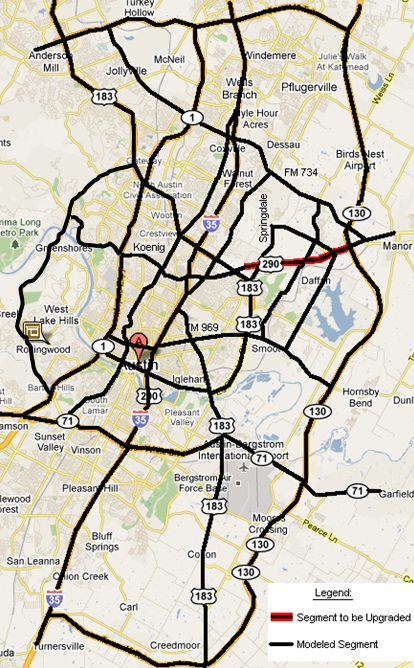
including pre-coded transportation networks for Austin,
Dallas-Ft. Worth, & Houston, Texas.
Moreover, it offers all uncompiled C++ and Visual Basic
codes and supporting documentation. Interested
parties can download the model and run PET using the existing Austin,
Dallas-Ft Worth, or Houston
networks -- or code new networks to develop and assess projects for their particular region of interest. Please note that PET is developed to handle
up to approximately 300 directional links at high
computing speeds, but can be adapted to handle more. Please be sure to read the linked
User's Guide
for instructions.
The code is copyrighted
to Kara Kockelman
and associated investigators. As an open-source
program, all use of codes, original or modified or extended,
must be freely shared with others, and appropriately
referenced. We look forward to hearing about your
applications of PET! And we welcome
questions.
|